



To describe exclusive breastfeeding (EBF) at 1 month postpartum among women receiving structured lactation support, by delivery mode and baseline infant feeding intentions (IFI), in a high-caesarean Greek population.
MethodSingle-arm pilot study without a comparison group, Patras, Greece (2024-2025). Third-trimester women received one 30-minute prenatal group session and individualised postnatal support at birth, 15 days and 1 month; IFI was assessed at baseline and breastfeeding status at 1 month (n=111).
ResultsAny breastfeeding reached 98.2% and EBF 84.7%; 64.5% delivered by caesarean section and 69.4% had high baseline intentions. Mean baseline IFI was higher among women exclusively breastfeeding at 1 month (13.4 versus 11.5; p=0.031). Breastfeeding status differed by delivery mode (exact p=0.021), with more supplementation after caesarean section; EBF did not (vaginal 89.7%, caesarean 81.7%; p=0.41).
ConclusionsHigh EBF was observed at 1 month. Without a comparison group and in a highly motivated sample, these findings describe observed patterns, not effectiveness.
Describir la lactancia materna exclusiva (LME) al mes posparto en mujeres con apoyo estructurado a la lactancia, según tipo de parto e intenciones de alimentación infantil (IAI) basales, en una población griega con alta tasa de cesárea.
MétodoEstudio piloto de un solo grupo, sin comparación (Patras, Grecia, 2024-2025). Las mujeres en el tercer trimestre recibieron una sesión grupal prenatal de 30 minutos y apoyo posnatal individualizado al nacimiento, a los 15 días y al mes; las IAI se evaluaron al inicio y el tipo de lactancia al mes (n=111).
ResultadosLa lactancia de cualquier tipo alcanzó el 98,2% y la LME el 84,7%; el 64,5% tuvieron cesárea y el 69,4% intenciones altas. La IFI basal media fue mayor con LME al mes (13,4 frente a 11,5; p=0,031). El tipo de lactancia difirió según el parto (p exacta=0,021), con más suplementación tras la cesárea; la LME no difirió (vaginal 89,7%, cesárea 81,7%; p=0,41).
ConclusionesSe observó una LME alta al mes. Sin grupo de comparación y con una muestra muy motivada, estos hallazgos describen patrones observados, no efectividad.
The World Health Organization (WHO) and the United Nations Children's Fund (UNICEF) recommend exclusive breastfeeding (EBF) from the first hour of birth through the first 6 months of life.1 EBF rates in the WHO European Region are among the lowest globally, with only 25% of infants exclusively breastfed at 6 months between 2006 and 2012.2,3 Greece ranks at the bottom, with fewer than 1% of infants exclusively breastfed at 6 months in 2017.4
Factors influencing breastfeeding include maternal education, mode of delivery, smoking and access to professional lactation support.5 Caesarean section has been consistently associated with lower initiation, delayed lactogenesis and shorter duration,6,7 and in Greece caesarean delivery and smoking in pregnancy are recognised barriers.4,8,9 Once established after caesarean delivery, however, breastfeeding continuation at 6 months is comparable to that after vaginal delivery,5 underlining the importance of early, targeted support.
The Health4EUKids Joint Action developed childhood obesity prevention strategies across European Member States, with early nutrition support as a fundamental component. Breastfeeding has been consistently identified as a modifiable factor protecting against later overweight.10 Within this framework we conducted a pilot of structured breastfeeding support in Patras, Greece, and describe EBF through the first month postpartum by baseline infant feeding intentions (IFI) and delivery mode. One month was chosen as the endpoint because early difficulties cluster in this window.
MethodWe conducted a single-arm prospective pilot intervention study, without a comparison group, in Patras, Greece, recruiting women in their third trimester between 2024 and 2025. All third-trimester women resident in the area who gave written informed consent were eligible, with no exclusion criteria; the number approached was not recorded, so no participation rate can be reported. Sample size reflected feasibility within a pilot phase, with no a priori power calculation.
An experienced lactation consultant delivered a single 30-minute small-group session after 30 weeks of gestation, repeated once for women unable to attend, covering the benefits of breastfeeding from the first hour of life, technical preparation, and strategies for the challenges associated with each delivery mode, supported by purpose-made videos. The same consultant then provided individualised support in person on the day of birth, by telephone or video call at 15 days, and in person at 1 month. Fidelity was not formally assessed: attendance and dose received were not recorded, although delivery by a single consultant using standardised material limits variation. The intervention is described in full, following the Template for Intervention Description and Replication (TIDieR) checklist, in Supplementary Material S1.
We assessed infant feeding intentions at baseline using the IFI scale,11,12 scored with the validated algorithm (range 0 to 16), defining high intention as 12 or more. Internal consistency in this sample was 0.71 (Cronbach's alpha); the translation procedure and item-level results are reported in Supplementary Material S1. Breastfeeding status at 1 month was self-reported, verified in person by the lactation consultant, cross-validated against source records, and classified as exclusive breastfeeding, breastfeeding with supplementation, or no breastfeeding.13
We compared categorical variables using Fisher's exact test, or a Monte Carlo exact test for tables larger than two by two, because several cells had fewer than five observations and one was empty, making the χ2 approximation unreliable. Mean IFI scores were compared between EBF and non-EBF groups using Student's t test, with the Mann-Whitney U test as a non-parametric check. Significance was set at p <0.05, two-tailed. Analyses were exploratory, unadjusted for multiplicity, and performed in Stata 19.0 (StataCorp, College Station, TX, USA).
The study protocol was approved by the Bioethics Committee of the University of Patras (ethics approval reference no. 304; 26 October 2023) and the study was conducted in accordance with the Declaration of Helsinki. All participants provided written informed consent. No identifiable personal data are reported.
ResultsOf 126 women completing the baseline questionnaire, 15 (11.9%) did not respond at 1 month, with no reason recorded, leaving an analytic sample of 111 women with linked baseline and 1-month records (retention 88.1%; Supplementary Figure 1). A further eight 1-month questionnaires, returned by women with no baseline record, were excluded, because IFI and mode of delivery were measured at baseline. Including these eight responses would change the 1-month EBF estimate from 84.7% to 84.9%. Assuming instead that all 15 women lost to follow-up had discontinued EBF, the estimated rate would be 74.6%.
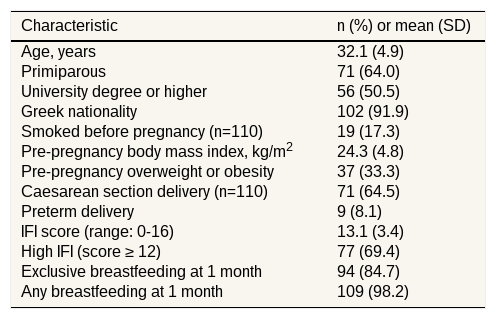
Mean age was 32.1 years (standard deviation [SD]: 4.9); baseline intentions were strong, with 69.4% in the high IFI category (Table 1). Among the 110 women with delivery data, 64.5% delivered by caesarean section. At 1 month, 98.2% were practising any breastfeeding and 84.7% EBF. Mean baseline IFI scores were higher among women exclusively breastfeeding at 1 month (13.4; SD: 3.3) than among those who were not (11.5; SD: 3.8; p=0.031; Mann-Whitney p=0.015). EBF was more frequent among women with high intention (88.3%) than among the rest (76.5%), but not significantly (exact p=0.15), and the study was not powered to detect this.
Baseline characteristics and 1-month breastfeeding outcomes of participants in the Health4EUKids breastfeeding pilot, Patras, Greece, 2024-2025 (n=111).
| Characteristic | n (%) or mean (SD) |
|---|---|
| Age, years | 32.1 (4.9) |
| Primiparous | 71 (64.0) |
| University degree or higher | 56 (50.5) |
| Greek nationality | 102 (91.9) |
| Smoked before pregnancy (n=110) | 19 (17.3) |
| Pre-pregnancy body mass index, kg/m2 | 24.3 (4.8) |
| Pre-pregnancy overweight or obesity | 37 (33.3) |
| Caesarean section delivery (n=110) | 71 (64.5) |
| Preterm delivery | 9 (8.1) |
| IFI score (range: 0-16) | 13.1 (3.4) |
| High IFI (score ≥ 12) | 77 (69.4) |
| Exclusive breastfeeding at 1 month | 94 (84.7) |
| Any breastfeeding at 1 month | 109 (98.2) |
IFI: infant feeding intentions; SD: standard deviation.
Values are n (%) unless otherwise indicated. Denominators are 111 unless stated otherwise. The IFI scale was scored 0 to 16 using the validated algorithm of Nommsen-Rivers and Dewey; high intention was defined a priori as a score of 12 or more. Exclusive breastfeeding denotes breast milk only, with no formula or other liquids, in the 24hours preceding the 1-month assessment.
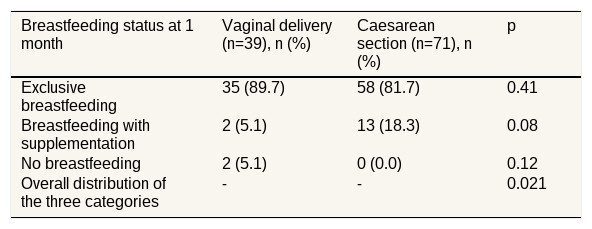
The overall distribution of breastfeeding status differed by delivery mode (exact p=0.021). Supplementation was more frequent after caesarean section (18.3%) than after vaginal delivery (5.1%), although not significantly (p=0.08), and the two women not breastfeeding at all had both delivered vaginally. EBF did not differ significantly between delivery modes (vaginal 89.7%, caesarean 81.7%; p=0.41); given the small sample this should not be read as evidence of equivalence (Table 2).
Breastfeeding status at 1 month by mode of delivery, Health4EUKids breastfeeding pilot, Patras, Greece, 2024-2025 (n=110).
| Breastfeeding status at 1 month | Vaginal delivery (n=39), n (%) | Caesarean section (n=71), n (%) | p |
|---|---|---|---|
| Exclusive breastfeeding | 35 (89.7) | 58 (81.7) | 0.41 |
| Breastfeeding with supplementation | 2 (5.1) | 13 (18.3) | 0.08 |
| No breastfeeding | 2 (5.1) | 0 (0.0) | 0.12 |
| Overall distribution of the three categories | - | - | 0.021 |
Percentages are column percentages. The p values for the individual categories are from Fisher's exact test comparing that category against all others; the p value for the overall distribution of the three categories is from a Monte Carlo exact test (50,000 permutations). Exact tests were used because several cells contained fewer than five observations and one cell was empty. Statistical significance was set at p <0.05, two-tailed. One woman had no mode-of-delivery data recorded and is excluded. Analyses are exploratory and are not adjusted for covariates or for multiplicity.
Most women in this pilot were breastfeeding exclusively 1 month after birth, in a setting where caesarean delivery predominated and national breastfeeding rates are among Europe's lowest. Having recruited a sample already strongly motivated to breastfeed, and without a comparison group, we describe what was observed among participants rather than what the programme achieved.
The rate we observed substantially exceeds nationally reported Greek figures, where EBF falls to approximately 40% by 1 month and below 1% at 6 months.4 Pre-existing motivation offers a plausible partial explanation.
The high caesarean rate reflects Greek obstetric practice and is a documented challenge for breastfeeding, through delayed lactogenesis, increased pain and reduced early mother-infant contact.6–8 In our cohort supplementation appeared more prevalent after caesarean delivery, though inconclusively, while EBF did not differ significantly, a comparison the study was not powered to make. This is compatible with the meta-analysis of Prior et al.,6 in which the association with lower early breastfeeding was largely confined to prelabour caesarean delivery. We did not record the indication, so could not distinguish prelabour from in-labour delivery.
Mean baseline IFI scores were higher among women exclusively breastfeeding at 1 month, although the comparison between intention categories was inconclusive. This is consistent with evidence on the predictive value of prenatal intentions5 and supports prenatal engagement.
Our study has limitations. The single-centre design, modest sample size and highly motivated sample limit generalisability, and the high, homogeneous EBF rate leaves little variance to detect differences, so non-significant subgroup comparisons may reflect type II error. Multivariable adjustment was not undertaken: with only 17 women not achieving EBF, events per variable fall well below accepted thresholds14; the comparisons reported are therefore descriptive. Fidelity and the participation rate were not recorded, and the Greek IFI version has not been formally validated. One-month follow-up cannot address EBF to 6 months, although difficulties and early cessation cluster in the first weeks;15 3- and 6-month follow-up is ongoing.
ConclusionsHigh EBF rates were observed through the first month among women receiving structured lactation support. These findings are best treated as hypotheses: formal evaluation would require a concurrent comparison group receiving usual care, an adequately powered sample, follow-up to at least 6 months, multi-site consecutive recruitment and prospective registration.
Availability of databases and material for replicationThe data underlying this article will be shared on reasonable request to the corresponding author.
Greece has among the lowest exclusive breastfeeding rates in Europe, with less than 1% at 6 months. Caesarean delivery is associated with delayed lactogenesis and lower early breastfeeding rates, and exclusive breastfeeding rates in the WHO European Region are low.
What does this study add to the literature?In a single-arm pilot in a high-caesarean-section Greek setting, high exclusive breastfeeding rates at 1 month were observed among women receiving structured prenatal and postnatal lactation support, in an already highly motivated sample.
What are the implications of the results?These hypothesis-generating findings support testing structured lactation support in a controlled, adequately powered, multi-site study with follow-up to at least 6 months before any inference about effectiveness.
Jorge Marcos-Marcos.
Transparency declarationThe corresponding author, on behalf of the other authors guarantee the accuracy, transparency and honesty of the data and information contained in the study, that no relevant information has been omitted and that all discrepancies between authors have been adequately resolved and described.
Authorship contributionsE. Magriplis conceived and designed the study, analysed the data and drafted the manuscript. S. Giannelou and N. Myrintzou contributed to participant recruitment, data collection and interpretation. E. Papachatzi drafted and edited the manuscript. A. Vantarakis supervised the study. All authors critically revised the manuscript and approved the final version.
AcknowledgementsWe thank the Work Package 6 leaders of Health4EUKids, Heli Kuusipalo, Taina Sainio, Kati Kuisma and Emma Koivurinta of the THL team. We are grateful to all Health4EUKids team members and to the participating mothers who generously shared their experiences.
FundingThis work was carried out within the Health4EUKids Joint Action, funded by the European Union under Grant Agreement No. 101079944 (EU4Health programme, grant number 101082462). The funder had no role in the study design, data collection, analysis, interpretation or the decision to submit for publication.
Conflicts of interestNone.