


This paper presents findings from the Portuguese pilot of the European Joint Action Health4EUKids, which tested participatory, multi-sectoral methods to design and implement policies for childhood obesity prevention. The action-research model implemented mobilized schools, families, municipalities, and health services to co-create interventions promoting children's biopsychosocial well-being. The assessment revealed that 66% of the children had a body mass index within the normal range, while 11% were overweight and 4% obese. Despite indicators of healthy eating habits, 36% of children did not meet WHO recommendations for daily physical activity. In terms of mental health, 57% reported irritability and 46.7% nervousness, although there were overall positive indicators of quality of life, well-being, and peer relationships. Differences were observed between sexes, with girls showing better levels of emotional well-being and boys showing greater involvement in physical activity. Screen dependence was moderate to high in about 50% of the sample, being more prevalent in urban areas. The application of the Living Healthy Tool revealed more favorable perceptions in rural areas while in urban areas greater barriers related to safety and access to sports infrastructures were identified. The study highlights the effectiveness of participatory governance for health promotion, offering policy pathways for actions on a national and European Union level.
Este artículo presenta los hallazgos del piloto portugués de la Acción Conjunta Europea Health4EUKids, que probó métodos participativos y multisectoriales para diseñar e implementar políticas para la prevención de la obesidad infantil. El modelo de investigación-acción movilizó a escuelas, familias, municipios y servicios de salud. La evaluación reveló que el 66% de los niños tenía un índice de masa corporal dentro del rango normal, mientras que el 11% tenía sobrepeso y el 4% obesidad. A pesar de los indicadores de hábitos alimenticios saludables, el 36% de los niños no cumplían con las recomendaciones de la OMS para la actividad física diaria. En términos de salud mental, el 57% reportaron irritabilidad y el 46,7% nerviosismo, aunque hubo indicadores generales positivos de calidad de vida, bienestar y relaciones entre pares. Se observaron diferencias entre sexos: las niñas mostraron mejores niveles de bienestar emocional y los niños una mayor participación en la actividad física. La dependencia de las pantallas fue de moderada a alta en aproximadamente el 50% de la muestra, siendo más frecuente en las zonas urbanas. La aplicación de la Living Healthy Tool reveló percepciones más favorables en las zonas rurales, mientras que en zonas urbanas se identificaron mayores barreras relacionadas con la seguridad y el acceso a infraestructuras deportivas. El estudio destaca la eficacia de la gobernanza participativa para la promoción de la salud, ofreciendo vías políticas para la acción en el ámbito nacional y de la Unión Europea.
Childhood obesity represents one of the most pressing public health challenges in Europe, requiring integrated, sustainable, and equity-oriented solutions. Understanding and intervening in health promotion must consider an ecological perspective and use a participatory methodology in order to encompass the complexity of the phenomenon and promote greater sustainability.1,2
In Portugal, approximately one-third of children aged 6–9 present overweight or obesity.3 Addressing these trends demands coordinated action across education, health, and local governance sectors. The Health4EUKids Joint Action aims to reduce inequalities in child health through evidence-based interventions and cross-country learning. The Portuguese pilot operationalized this approach in the district of Portalegre in Alentejo region, emphasizing co-creation, participatory governance, and ecological health promotion. The study explores how local participatory processes can inform and strengthen national and European child health policies.
MethodStudy typeThis is an observational, cross-sectional, community-based study, framed within a participatory action research approach and using a mixed methods approach (quantitative and qualitative), guided by the Intervention Mapping framework. It was developed by the scope of the Portuguese pilot project of the European Joint Action Health4EUkids, with an exploratory and formative objective to support the design of local policies for the prevention of childhood obesity.
Context and period of studyThe study was conducted in two municipalities in the Alto Alentejo region of Portugal, with distinct territorial characteristics: urban (Portalegre) and a rural (Alter do Chão) municipality, during the pilot phase of the project (2024/2025), including three phases: 1) quantitative diagnosis of the biopsychosocial health of school-age children; 2) assessment of community assets promoting healthy lifestyles; and 3) implementation and evaluation of health promotion activities. The intervention model was guided by the Intervention Mapping framework and by principles of participatory and intersectoral governance, involving schools, municipalities, health services, families, and other community actors.
Study population and inclusion and exclusion criteriaThe target population of the study included school-aged children, between 6 and 10 years old, enrolled in public schools in the two municipalities, as well as teachers, parents/guardians, health professionals, and other community members involved in the project activities.
Children with regular school attendance were included, provided that their parents/guardians signed informed consent. Children with significant difficulties in understanding the instruments or who did not provide informed consent were excluded. For the instruments directed at the community, participants directly involved in school, family, or community contexts were included.
Sampling methodA convenience sample was used, based on the voluntary participation of schools, families, and community participants. The sample included 202 children in the school survey, 54 participants in the community survey, 61 students in the satisfaction questionnaire, and 5 education professionals. No formal sample size calculation was performed, as this is a pilot study with an exploratory nature and oriented towards the development of intervention models.
Data collection instrumentsData collection was carried out using different instruments. The assessment of the biopsychosocial health of the children used the Health Behaviour in School-aged Children (HBSC) protocol, adapted to the 6-10 year age group.4 The assessment of community participants was carried out using the Living Healthy Tool, which analyzes 16 dimensions related to health-promoting environments in school, family and community contexts. Additionally, satisfaction questionnaires were applied to students and professionals, complemented by the collection of qualitative feedback. The interventions were co-constructed with the different local stakeholders, involving schools, municipalities and health services.
Study proceduresThe instruments were applied in school and community settings by previously trained professionals, following standardized procedures. Pre-tests were conducted to ensure linguistic adequacy and comprehension of the items. Body mass index was calculated from weight and height, with data collected by healthcare professionals and classified according to World Health Organization (WHO) criteria for age and sex. Physical activity was operationalized as compliance or non-compliance with the recommendation of ≥60minutes daily. Screen dependence was classified as low, moderate, and high based on the average daily number of hours. Participatory activities involved co-creation sessions, joint reflection, and feedback of results to local stakeholders.
Statistical analysisDescriptive statistics (frequencies, means, and confidence intervals) were calculated. For comparisons between urban and rural contexts, χ2 tests and Student's t-tests were used, when appropriate, considering significance levels of 5%. The analysis was essentially descriptive, and no adjusted multivariate models were performed. Quantitative analysis was performed using SPSS software (version 28).
Qualitative data collected through questionnaires and the Living Health Tool instrument were analyzed using thematic analysis to identify facilitators, barriers, and recommendations for the implementation and sustainability of the interventions.
Ethical considerationsThe study obtained approval from the Ethics Committee (IRB). Informed consent was obtained from the children's guardians and all adult participants. Data confidentiality and anonymity were ensured at all stages of the study.
DisclaimerViews and opinions expressed are those of the authors only and do not necessarily reflect those of the European Union or HADEA. Neither the European Union nor the granting authority can be held responsible for them.
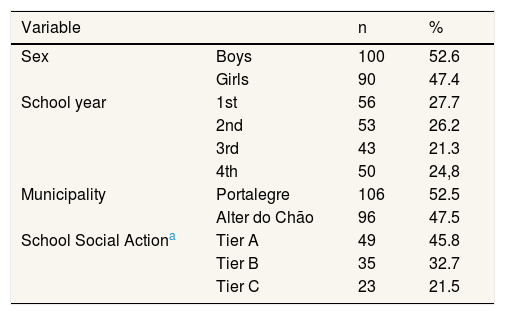
ResultsThis study included 202 primary school students, 52.6% (n=100) boys and 47.4% (n=90) girls, aged 6 to 10. It should be noted that 12 students did not answer the gender question. Regarding geographical distribution, 52.5% reside in the municipality of Portalegre and 47.5% in Alter do Chão. Concerning school years, the largest percentage of students are in the 1st and 2nd years of schooling.
Regarding socioeconomic status (ASE), among the beneficiary students 45.8% (n=49) reports having social action level A, indicating that a significant part of the sample is from a context of greater economic vulnerability (Table 1).
Sociodemographic characterization of the sample.
| Variable | n | % | |
|---|---|---|---|
| Sex | Boys | 100 | 52.6 |
| Girls | 90 | 47.4 | |
| School year | 1st | 56 | 27.7 |
| 2nd | 53 | 26.2 | |
| 3rd | 43 | 21.3 | |
| 4th | 50 | 24,8 | |
| Municipality | Portalegre | 106 | 52.5 |
| Alter do Chão | 96 | 47.5 | |
| School Social Actiona | Tier A | 49 | 45.8 |
| Tier B | 35 | 32.7 | |
| Tier C | 23 | 21.5 |
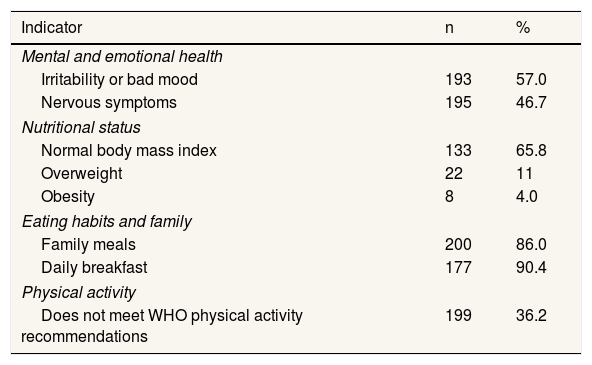
The biopsychosocial assessment identified the coexistence of protective and risk factors in the individual, behavioral, and contextual domains. Regarding mental and emotional health, a moderate prevalence of irritability (57%) and nervousness (46.7%) was reported, coexisting with overall positive perceptions of quality of life and peer relationships. Gender differences were observed, with girls showing higher levels of emotional well-being and boys’ greater involvement in physical activity. Regarding physical health, most children had a body mass index within the normal range (66%), with cases of overweight (11%) and obesity (4%) also identified. Although indicators of consistent eating routines were observed, such as daily breakfast and frequent family meals, reported by 90% of participants, more than a third of the sample did not meet the World Health Organization's recommendations for daily physical activity.
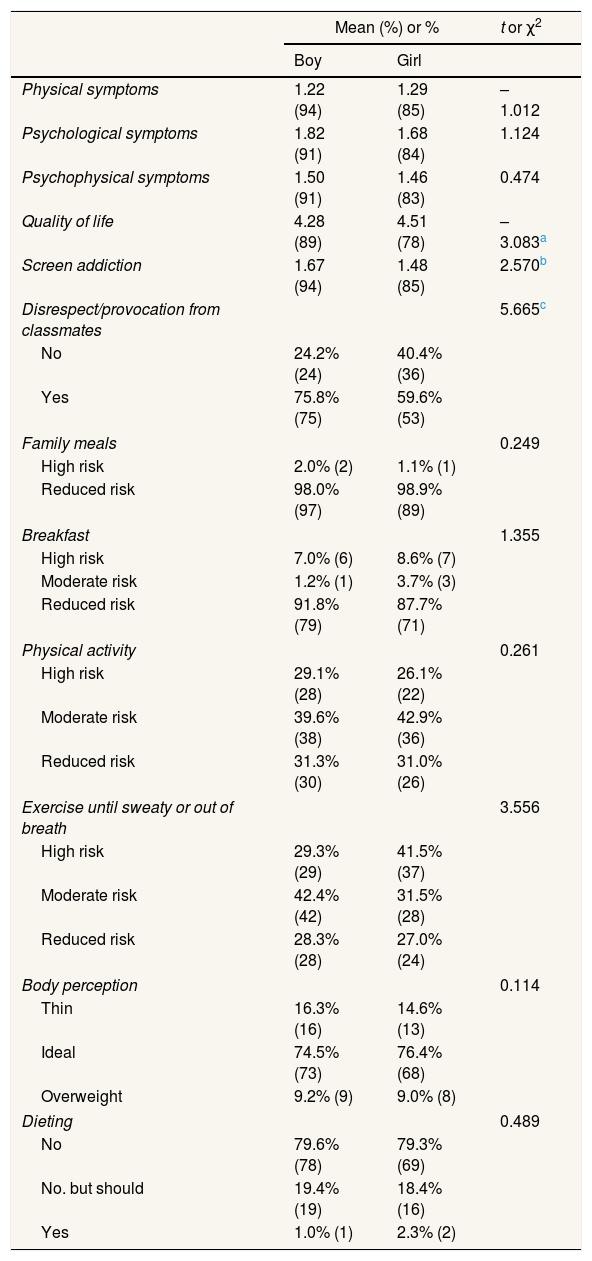
Analysis of lifestyle patterns revealed moderate to high screen dependence in about half of the sample, particularly in urban settings, while children from rural areas reported healthier leisure routines and greater community involvement (Tables 2 and 3).
Average comparisons.
| Mean (%) or % | t or χ2 | ||
|---|---|---|---|
| Boy | Girl | ||
| Physical symptoms | 1.22 (94) | 1.29 (85) | –1.012 |
| Psychological symptoms | 1.82 (91) | 1.68 (84) | 1.124 |
| Psychophysical symptoms | 1.50 (91) | 1.46 (83) | 0.474 |
| Quality of life | 4.28 (89) | 4.51 (78) | –3.083a |
| Screen addiction | 1.67 (94) | 1.48 (85) | 2.570b |
| Disrespect/provocation from classmates | 5.665c | ||
| No | 24.2% (24) | 40.4% (36) | |
| Yes | 75.8% (75) | 59.6% (53) | |
| Family meals | 0.249 | ||
| High risk | 2.0% (2) | 1.1% (1) | |
| Reduced risk | 98.0% (97) | 98.9% (89) | |
| Breakfast | 1.355 | ||
| High risk | 7.0% (6) | 8.6% (7) | |
| Moderate risk | 1.2% (1) | 3.7% (3) | |
| Reduced risk | 91.8% (79) | 87.7% (71) | |
| Physical activity | 0.261 | ||
| High risk | 29.1% (28) | 26.1% (22) | |
| Moderate risk | 39.6% (38) | 42.9% (36) | |
| Reduced risk | 31.3% (30) | 31.0% (26) | |
| Exercise until sweaty or out of breath | 3.556 | ||
| High risk | 29.3% (29) | 41.5% (37) | |
| Moderate risk | 42.4% (42) | 31.5% (28) | |
| Reduced risk | 28.3% (28) | 27.0% (24) | |
| Body perception | 0.114 | ||
| Thin | 16.3% (16) | 14.6% (13) | |
| Ideal | 74.5% (73) | 76.4% (68) | |
| Overweight | 9.2% (9) | 9.0% (8) | |
| Dieting | 0.489 | ||
| No | 79.6% (78) | 79.3% (69) | |
| No. but should | 19.4% (19) | 18.4% (16) | |
| Yes | 1.0% (1) | 2.3% (2) | |
Biopsychosocial health indicators.
| Indicator | n | % |
|---|---|---|
| Mental and emotional health | ||
| Irritability or bad mood | 193 | 57.0 |
| Nervous symptoms | 195 | 46.7 |
| Nutritional status | ||
| Normal body mass index | 133 | 65.8 |
| Overweight | 22 | 11 |
| Obesity | 8 | 4.0 |
| Eating habits and family | ||
| Family meals | 200 | 86.0 |
| Daily breakfast | 177 | 90.4 |
| Physical activity | ||
| Does not meet WHO physical activity recommendations | 199 | 36.2 |
n varies between indicators due to incomplete responses. Overweight and obesity classification according to body mass index.
At the community level, the Living Healthy Tool showed more favorable perceptions in rural areas regarding access to safe outdoor spaces, social cohesion, and health-promoting food environments, while urban participants highlighted barriers associated with safety and access to sports facilities. Across the board, satisfaction levels with the activities carried out were high among students and professionals, who reported greater awareness, strengthened intersectoral collaboration, and increased community empowerment.
DiscussionOverall, the results of this pilot study highlight the added value of participatory approaches and mixed methods in understanding the multidimensional determinants of child health and in strengthening local ownership and sustainability of health promotion actions, particularly in differentiated territorial contexts.
At the policy level, the Health4EUKids project demonstrated strategic relevance by fostering intersectoral governance and informing future public health planning. The development of Policy Brief and locally implemented actions aligned with national health priorities, reinforcing sustainability and institutional commitment. A major methodological advancement was the adaptation of the HBSC protocol to younger age groups (6–10 years), expanding its scope beyond the traditional adolescent cohort. This innovation enhanced the capacity to monitor early health determinants and will inform future iterations of the National Health in Schools Program. The implementation in Alter do Chão and Portalegre, two small municipalities sharing institutional frameworks but differing in their urban–rural profiles, provided valuable comparative insights and strengthened the transferability of lessons learned to other Portuguese contexts.
The study reveals a complex biopsychosocial profile among school-aged children. In terms of physical health, most children presented a body mass index within the normal range (66%), although a moderate prevalence of overweight (11%) and obesity (4%) was also observed. This profile reflects the coexistence of both protective and risk factors, which is particularly relevant in the context of early childhood obesity prevention. The presence of structured family routines was highlighted by the fact that 90% of children consumed breakfast daily and shared frequent family meals, both of which are behaviors recognized as key drivers of healthy development and building long-term health resilience.4–7 However, more than one-third of the sample did not meet the WHO's recommendations for daily physical activity, and a high dependence on screens was observed, especially in urban contexts. These findings underscore the need for integrated interventions that promote active lifestyles and healthy behaviors from early childhood, particularly in urban environments.4,5
Regarding mental and emotional health, the results indicate a complex interplay between risk and protective factors. A significant proportion of children reported moderate levels of irritability and nervousness, yet these psychological symptoms coexisted with generally positive perceptions of quality of life and peer relationships. This duality highlights the complexity of psychosocial development in childhood and aligns with evidence suggesting that supportive relationships can mitigate the negative effects of stress on well-being.6–8
The application of the Living Healthy Tool allowed for a deeper analysis of the contextual determinants of health, highlighting relevant territorial differences. The more favorable perceptions in rural areas regarding community cohesion, social trust, and access to safe outdoor spaces are consistent with studies that emphasize the role of social capital and the built environment in promoting healthy lifestyles. In contrast, the barriers identified in the urban context reinforce previous evidence on inequalities in access to infrastructure and safe environments for physical activity.
Taken together, these results support the importance of holistic approaches that address both physical and psychosocial dimensions of child health, emphasizing the value of participatory and context-sensitive strategies to enhance well-being and prevent obesity from an early age.5–9
Moreover, the co-creation process promoted intersectoral dialogue between health and education systems, often fragmented in practice. This participatory governance model aligns with the WHO Health in All Policies framework and the EU's 2024–2030 Strategy for Childhood Obesity Prevention, illustrating how community engagement can operationalize these high-level goals at the municipal level.10
Despite the contributions of the study, some limitations should be noted. The small sample size, particularly regarding the instruments applied to the community and professionals, limits the generalizability of the results. The short duration of the study prevents the evaluation of medium- and long-term effects of the interventions. Additionally, the use of self-report-based instruments may induce response biases. However, the triangulation of methods and information collected support the ecological validity of the results, as advocated by the methodological literature in community health research.11
ConclusionsThe Portuguese Health4EUKids pilot show the added value of participatory and multi-level governance models in translating evidence into action for childhood obesity prevention. By aligning local knowledge, scientific evidence, and policy priorities, the approach strengthened intersectoral collaboration, promoted health literacy, and supported more equitable and context-sensitive health promotion strategies. The findings suggest that embedding co-creation processes within local governance structures enhances sustainability and community ownership, particularly in diverse urban and rural settings. Scaling this model nationally and across European contexts could meaningfully contribute to the implementation of the National Health in Schools Program, the Portuguese National Health Plan 2030, and the achievement of the United Nations Sustainable Development Goals related to health and equity (SDG 3 and SDG 10).
Policy implicationsBased on the study results, implications for the formulation of public policies in the field of child health can be identified, anchored in the evidence produced by the study:
Integration of participatory processes at the local level: the high acceptance of the activities carried out by children and professionals suggests that the inclusion of co-creation mechanisms in municipal health and education planning processes can strengthen local ownership of interventions.
Strengthening intersectoral coordination at a municipal level: the observed collaboration between schools, municipalities, and health services shows that permanent intersectoral partnerships can facilitate the implementation of consistent actions to promote children's health.
Use of community assessment tools: the application of the Living Healthy Tool proved useful in identifying contextual assets and barriers to the promotion of healthy lifestyles, suggesting its potential as a tool to support decision-making at the local level.
Adaptation of interventions to the territorial context: the differences identified between urban and rural contexts highlight the need for policies tailored to local characteristics, particularly regarding access to safe spaces, infrastructure, and community networks.
Contribution to European collaborative initiatives: the experience of the Portuguese pilot study provides empirical evidence on the applicability of participatory approaches and mixed methods in local contexts and may inform future collaborative actions within the framework of European initiatives to promote child health.
Editor in chargeJosé Manuel Jiménez Rodríguez.
Transparency declarationThe corresponding author, on behalf of the other authors guarantee the accuracy, transparency and honesty of the data and information contained in the study, that no relevant information has been omitted and that all discrepancies between authors have been adequately resolved and described.
Authorship contributionsT. Gaspar conceptualized the study design, conducted the analyses, original draft preparation and critically reviewed the final manuscript, supervision, discussion and conclusions, methodology and formal analysis, investigation. M.R. Nóbrega: data collection, data analysis, result description, writing, review and editing, investigation. F. Botelho Guedes: data analysis, result description, writing, review and editing. A. Cerqueira: writing, review and editing, investigation. L. Quelhas Pinto: project administration, supervision, writing, review and editing. M. Telo de Arriaga: project administration, contributed to the study conceptualization and critically reviewed the manuscript and the results, writing, review and funding acquisition. All authors have read and agreed to the published version of the manuscript.
AcknowledgementsThe authors thank the municipalities of Portalegre and Alter do Chão, the Local Health Unit of Alto Alentejo, the participating schools, educators, families, and children.
FundingHealth4EUKids Joint Action is funded by the European Union under the grant agreement No. 101079944.
Conflicts of interestNone.