


To estimate the lifetime prevalence ratios of experiences of sexual violence and analyze the sociodemographic factors associated with this type of violence in young adults.
MethodData were drawn from the 2022 Chilean National Survey of Health, Sexuality, and Gender. Analysis included 1003 young adults aged 18–19 years. Lifetime prevalence of sexual harassment and violence included experiences ranging from verbal harassment and inappropriate comments to forced sexual contact. Prevalence was estimated by sex, and associated factors were analyzed using robust Poisson regression models to estimate crude and adjusted prevalence ratios.
ResultsOverall, 59.0% (95% CI: 55.9-62.0) reported at least one lifetime experience of sexual violence, with prevalence estimates of 52.0% (95% CI: 46.5-57.5) among men and 62.3% (95% CI: 58.6-65.8) among women. Prevalence was higher among women (aPR: 1.21; 95% CI: 1.07-1.35) and non-heterosexual participants (aPR: 1.49; 95% CI: 1.35-1.63) compared with their reference groups.
ConclusionsThis study demonstrates that experiences of sexual violence have an high prevalence among young adults. The differential associations due to sex assigned at birth and sexual orientation constitute a key basis for the development of interventions aimed at promoting safe youth development and a transition to adulthood with the least possible burden on mental and physical health.
Estimar las razones de prevalencia de vida de experiencias de violencia sexual y analizar los factores sociodemográficos asociados en personas jóvenes.
MétodoLa muestra se obtuvo de la Encuesta Nacional de Salud, Sexualidad y Género de Chile en 2022. El análisis incluyó 1003 jóvenes de 18 y 19 años. Las experiencias de vida de acoso y violencia sexual incluyeron desde acoso verbal y comentarios inapropiados hasta contacto sexual forzado. La prevalencia se estimó según sexo y los factores asociados fueron analizados usando el modelo de regresión de Poisson para calcular razones de prevalencia crudas y ajustadas.
ResultadosEn general, el 59,0% (IC95%: 55,9-62,0) reportaron haber experimentado al menos una experiencia de violencia sexual en su vida, con estimados de prevalencia del 52,0% (IC95%: 46,5-57,5) en hombres y el 62,3% (IC95%: 58,6-65,8) en mujeres. La prevalencia es mayor en mujeres (aPR: 1,21; IC95%: 1,07-1,35) y en no heterosexuales (aPR: 1,49; IC95%: 1,35-1,63) en comparación con sus grupos de referencia.
ConclusionesLas experiencias de violencia sexual presentan una prevalencia elevada entre la población joven. Las asociaciones según sexo y orientación sexual constituyen una base clave para el desarrollo de intervenciones orientadas a promover un desarrollo juvenil seguro y una transición a la adultez con la menor carga posible sobre la salud mental y física.
Sexual violence remains a critical global public health issue due to its strong links to sexual and reproductive health and rights. The World Health Organization (WHO) defines sexual health as a “physical, emotional, mental and social state of wellbeing in relation to sexuality, that requires a positive and respectful approach to sexuality and sexual relationships, as well as the possibility of having pleasurable and safe sexual experiences, free of coercion, discrimination and violence”.1 Within this framework, sexual violence represents a direct violation of sexual health. While the Centers for Disease Control and Prevention define sexual violence as any sexual activity without consent2 the WHO defines it as “any sexual act, attempt to obtain a sexual act, or other act directed against a person's sexuality using coercion, by any person regardless of their relationship to the victim, in any setting. It includes rape, attempted rape, unwanted sexual touching and other non-contact forms”.3 Evidence suggests that sexual violence has long term effects on mental and physical health such as injuries, sleep disorders, unwanted pregnancies for women or pregnancy complications, sexually transmitted infections, human immunodeficiency virus, depression, anxiety, suicidal thoughts, post-traumatic stress and even death.4–6 Sexual violence also contributes to a normalization of violence that can reverberate in generational cycles of abuse that center in power imbalance acted through constructed stereotypes of gender.7
Exposure to trauma at a young age, including child sexual abuse, can impair physical and psychological development during childhood and adolescence. These experiences are associated with increased psychosocial, psychiatric, and physical health problems, and have been strongly linked to schizophrenia, post-traumatic stress disorder, and substance use disorders in adulthood.8–11 Individuals that have experienced a sexual violence experience during formative years are at higher risk of re-experiencing similar events later in life.12,13 From a health system perspective, survivors of violence represent a significant burden due to the requirements of emergency medical care, rehabilitation, and long-term psychological support.14 Sexual violence experiences can affect social cohesion, hamper their ability to form and maintain healthy relationships, which in turn may hinder their prospect for social mobility.15
The prevalence of sexual violence varies across studies and settings; however, available evidence consistently demonstrates its widespread impact across the life course. A survey conducted in the United States of America found that 73% of women and 24% of men had experienced sexual harassment in public spaces.16 Furthermore, a UNICEF report compiling global data estimated that one in five girls and women, and one in seven boys and men, were subjected to sexual violence during childhood.17 Studies have also shown that a considerable proportion of adolescents experience sexual harassment before adulthood,18,19 highlighting adolescence as a particularly vulnerable stage for sexual victimization. Globally, it is estimated that one in three adult women aged 15 to 49 reported having experienced intimate partner violence at least once in their lifetime,20 the estimated lifetime prevalence of intimate partner violence in the Americas is approximately 25%.21 The country also manifests socio-politically conservative and patriarchal characteristics that may contribute to gender-based violence.
Sexual violence encompasses both non-contact forms (e.g., exhibitionism, exposure to pornography, and verbal sexual harassment) and contact forms (e.g., rape and unwanted sexual touching).22 In Chile, sexual violence is understood as a series of acts or assaults that affect the sexual integrity of a person and is recognized as a violation of human rights.23 Women are the most common victims of sexual violence in the country, with a significant proportion of cases affecting girls and adolescents.8 During 2022, 1715 individuals were treated in emergency units due to a contact sexual assault of whom more than 90% identified as women and approximately 29% were between 10 and 17 years of age.24
A recent study evaluated the first year of implementation of the 86th Explicit Health Guarantees policy, which provides comprehensive health services for survivors of acute sexual assault. The study identified distinct patterns of vulnerability differentiated by sex and age.25 Among women, cases were concentrated in the 10-14 age group, followed by individuals aged 15-24 and 25-44 years. Among men, the highest number of reported cases occurred among children aged 0–9 years, suggesting that sexual victimization may begin at very early stages of life.
Few studies have examined lifetime experiences of sexual harassment and violence among 18-19-year-olds in Chile, particularly among groups disproportionately exposed to violence, including women, non-heterosexual individuals, and those experiencing socioeconomic disadvantage.5,9,10,26 This study aimed to estimate the lifetime prevalence of sexual harassment and violence and examine associated sociodemographic factors among 18–19-year-olds participating in the National Survey of Health, Sexuality and Gender (ENSSEX, for its Spanish acronym).
MethodThis cross-sectional study used secondary data from the ENSSEX, a nationally representative survey conducted by the Chilean Ministry of Health every 6 years. Data were obtained from the most recent survey wave, conducted between August and December 2022. ENSSEX used a multistage probabilistic, geographically representative sampling design and achieved 20,392 completed interviews from an oversampled national sample of 39,970 individuals. Data collection was conducted face-to-face using electronic devices administered by trained interviewers, with self-administered modules for sensitive topics. Detailed response and eligibility information are available in the survey methodological report.
The survey population included individuals aged 18 years and older from all sixteen regions of Chile. For this study, analyses were restricted to participants aged 18–19 years, given the focus on sexual violence experiences occurring during key developmental stages including infancy, childhood, and adolescence. ENSSEX includes modules on sociodemographic characteristics, wellbeing and general health, sexual education and socialization, sexual trajectories, partner relationships, sexual practices, gender identity and sexual orientation, sexual and reproductive health, and sexual violence. To fulfill this study's objective, the data in this analysis are comprised of the sexual violence and characterization modules.
A total of 20,932 people were surveyed. We excluded those over 19 years (n=19,278) and those with missing data or responses such as “Don’t know” or “Prefer not to answer” in key variables in the sexual violence module (n=111). For other variables without responses, a specific category was created to ensure inclusion and transparency in results. The final sample of the study was 1003 young adults.
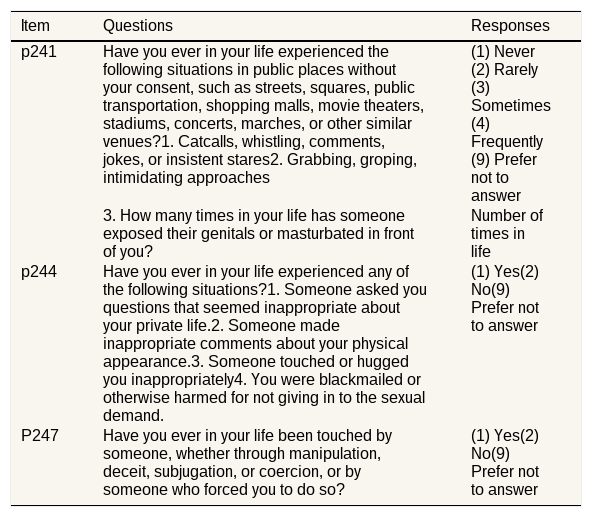
The primary outcome of the study was sexual violence. Variables from the survey's sexual violence module were analyzed to assess lifetime experiences of different forms of sexual violence, ranging from verbal harassment and inappropriate comments to forced sexual contact. Responses to these items included both continuous and categorical variables. Variables with ordinal response categories were dichotomized as “Yes” when participants answered “Rarely”, “Sometimes”, or “Frequently”, and as “No” when the response was “Never”. Count variables were dichotomized as “Yes” when participants reported one or more events and as “No” when the response was zero. Contact sexual violence included physical sexual harassment, inappropriate sexually charged contact, and forced or coerced sexual contact, whereas non-contact sexual violence included public verbal harassment, genital exhibitionism, questioning about intimacy, inappropriate comments about physical appearance, and retaliation after refusing sexual solicitation. Participants were considered to have experienced sexual violence if they reported at least one of the aforementioned events. Table 1 presents the questions used in this analysis.
Questions used in manuscript.
| Item | Questions | Responses |
|---|---|---|
| p241 | Have you ever in your life experienced the following situations in public places without your consent, such as streets, squares, public transportation, shopping malls, movie theaters, stadiums, concerts, marches, or other similar venues?1. Catcalls, whistling, comments, jokes, or insistent stares2. Grabbing, groping, intimidating approaches | (1) Never(2) Rarely(3) Sometimes(4) Frequently(9) Prefer not to answer |
| 3. How many times in your life has someone exposed their genitals or masturbated in front of you? | Number of times in life | |
| p244 | Have you ever in your life experienced any of the following situations?1. Someone asked you questions that seemed inappropriate about your private life.2. Someone made inappropriate comments about your physical appearance.3. Someone touched or hugged you inappropriately4. You were blackmailed or otherwise harmed for not giving in to the sexual demand. | (1) Yes(2) No(9) Prefer not to answer |
| P247 | Have you ever in your life been touched by someone, whether through manipulation, deceit, subjugation, or coercion, or by someone who forced you to do so? | (1) Yes(2) No(9) Prefer not to answer |
Independent variables included assigned sex at birth, education level, sexual orientation, income, nationality, belonging to an indigenous group, and region zone. Nationality was dichotomized into Chilean and foreign, sex assigned at birth was categorized into men and women, education was categorized into secondary education and middle school or less. Sexual orientation was included as heterosexual and homosexual/bisexual/others and income was divided in terciles, from 0 to 20,000,000 Chilean pesos a month. The sixteen regions were condensed into three macro regions: North (Arica y Parinacota, Tarapacá, Antofagasta, Atacama, Coquimbo), Center (Valparaíso, Metropolitana, O’Higgins, Maule, Ñuble), and South (Biobío, La Araucanía, Los Ríos, Los Lagos, Aysén, Magallanes), in order to capture spatial patterns and reduce analytical fragmentation. Due to the high proportion of missing responses for income, this variable was excluded from the adjusted regression model.
The overall sample was characterized by sex using frequencies and percentages. Lifetime prevalence estimates for different types of sexual violence experiences were calculated and compared by sex using Pearson's χ2 test. Lifetime prevalence estimates and 95% confidence intervals (95%CI) were also calculated according to key sociodemographic variables. Robust Poisson regression models were used to estimate crude prevalence ratio (cPR) and adjusted prevalence ratio (aPR), and their corresponding 95%CI. Statistical significance was defined as p <0.05. All analyses were conducted using Stata version 19.
This study used a publicly available data set from the Encuesta Nacional de Salud, Sexualidad y Género (ENSSEX) coordinated by the Ministry of Health. Data has been anonymized ensuring participant confidentiality.
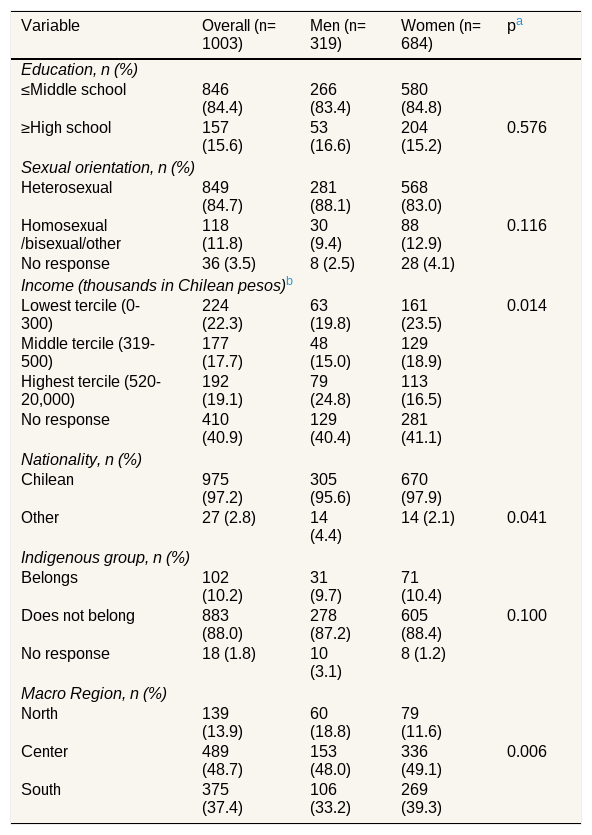
ResultsA total of 1003 individuals were included in the study. As shown in Table 2, women represented 68.2% of the sample, and the majority of participants had completed middle school education or less (84.4%). Participants identifying as non-heterosexual accounted for 11.8% of the sample. Regarding income, 40.9% of participants did not provide a response, while 22.3% were classified within the lowest income tercile (0–300,000 Chilean pesos). Additionally, 10.2% of participants identified as belonging to an Indigenous group, and nearly half of the sample (48.8%) resided in the Central macro-region.
Characterization of the sample by sex (n=1003).
| Variable | Overall (n=1003) | Men (n=319) | Women (n=684) | pa |
|---|---|---|---|---|
| Education, n (%) | ||||
| ≤Middle school | 846 (84.4) | 266 (83.4) | 580 (84.8) | |
| ≥High school | 157 (15.6) | 53 (16.6) | 204 (15.2) | 0.576 |
| Sexual orientation, n (%) | ||||
| Heterosexual | 849 (84.7) | 281 (88.1) | 568 (83.0) | |
| Homosexual/bisexual/other | 118 (11.8) | 30 (9.4) | 88 (12.9) | 0.116 |
| No response | 36 (3.5) | 8 (2.5) | 28 (4.1) | |
| Income (thousands in Chilean pesos)b | ||||
| Lowest tercile (0-300) | 224 (22.3) | 63 (19.8) | 161 (23.5) | 0.014 |
| Middle tercile (319-500) | 177 (17.7) | 48 (15.0) | 129 (18.9) | |
| Highest tercile (520-20,000) | 192 (19.1) | 79 (24.8) | 113 (16.5) | |
| No response | 410 (40.9) | 129 (40.4) | 281 (41.1) | |
| Nationality, n (%) | ||||
| Chilean | 975 (97.2) | 305 (95.6) | 670 (97.9) | |
| Other | 27 (2.8) | 14 (4.4) | 14 (2.1) | 0.041 |
| Indigenous group, n (%) | ||||
| Belongs | 102 (10.2) | 31 (9.7) | 71 (10.4) | |
| Does not belong | 883 (88.0) | 278 (87.2) | 605 (88.4) | 0.100 |
| No response | 18 (1.8) | 10 (3.1) | 8 (1.2) | |
| Macro Region, n (%) | ||||
| North | 139 (13.9) | 60 (18.8) | 79 (11.6) | |
| Center | 489 (48.7) | 153 (48.0) | 336 (49.1) | 0.006 |
| South | 375 (37.4) | 106 (33.2) | 269 (39.3) | |
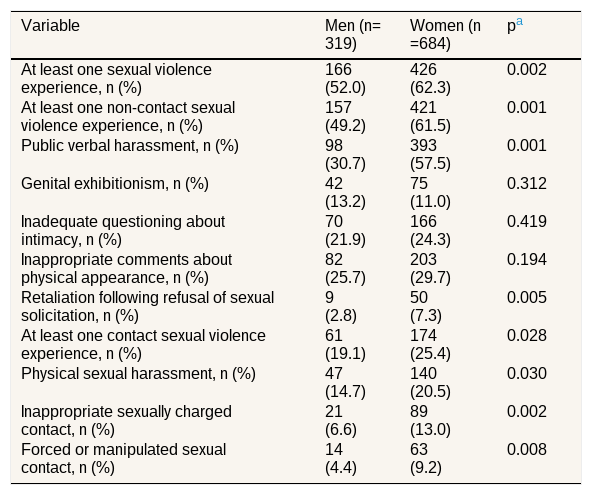
Table 3 presents the prevalence of lifetime sexual violence experiences by sex and their associations. Women reported a higher prevalence of lifetime sexual violence experiences than men (62.3% vs. 52.0%; p <0.002). The most commonly reported form of sexual violence among both women and men was public verbal harassment (57.5% and 30.7%, respectively; p <0.001), followed by inappropriate comments about physical appearance (29.7% and 25.7%, respectively; p=0.194), inadequate questioning about intimacy (24.3% and 21.9%, respectively; p=0.419), and physical sexual harassment (20.5% and 14.7%, respectively; p <0.030). Statistically significant associations by sex were observed for overall sexual violence experiences, public verbal harassment, physical sexual harassment, inappropriate sexually charged contact, retaliation after refusing sexual solicitation, and forced or coerced sexual contact.
Lifetime prevalence of sexual harassment or violence experiences, by sex assigned at birth.
| Variable | Men (n=319) | Women (n=684) | pa |
|---|---|---|---|
| At least one sexual violence experience, n (%) | 166 (52.0) | 426 (62.3) | 0.002 |
| At least one non-contact sexual violence experience, n (%) | 157 (49.2) | 421 (61.5) | 0.001 |
| Public verbal harassment, n (%) | 98 (30.7) | 393 (57.5) | 0.001 |
| Genital exhibitionism, n (%) | 42 (13.2) | 75 (11.0) | 0.312 |
| Inadequate questioning about intimacy, n (%) | 70 (21.9) | 166 (24.3) | 0.419 |
| Inappropriate comments about physical appearance, n (%) | 82 (25.7) | 203 (29.7) | 0.194 |
| Retaliation following refusal of sexual solicitation, n (%) | 9 (2.8) | 50 (7.3) | 0.005 |
| At least one contact sexual violence experience, n (%) | 61 (19.1) | 174 (25.4) | 0.028 |
| Physical sexual harassment, n (%) | 47 (14.7) | 140 (20.5) | 0.030 |
| Inappropriate sexually charged contact, n (%) | 21 (6.6) | 89 (13.0) | 0.002 |
| Forced or manipulated sexual contact, n (%) | 14 (4.4) | 63 (9.2) | 0.008 |
Pearson's χ2 test.
Non-contact sexual violence included public verbal harassment, genital exhibitionism, inadequate questioning, inappropriate comments, and retaliation following refusal of sexual solicitation. Contact sexual violence included physical sexual harassment, inappropriate sexual contact, and forced or manipulated sexual contact. Categories were not mutually exclusive.
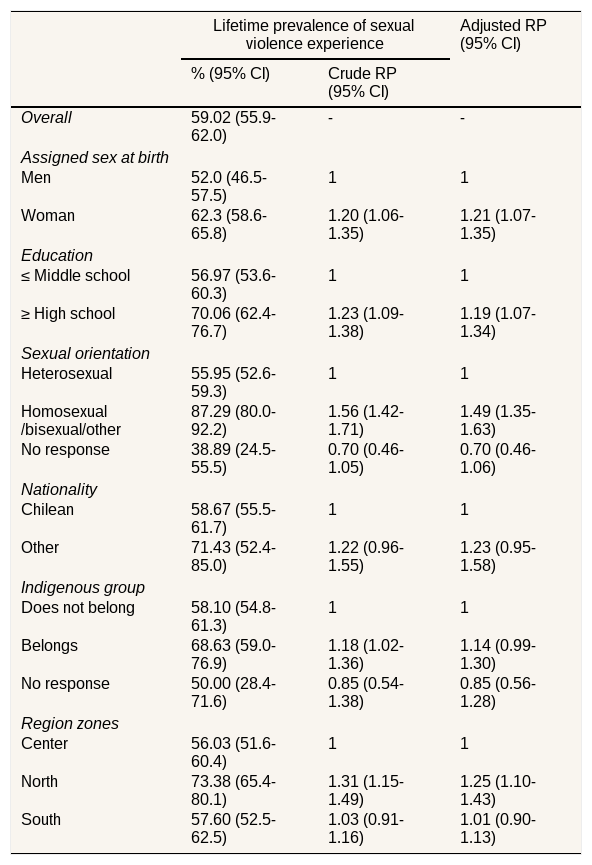
Table 4 presents the prevalence of lifetime sexual violence experiences and their associated factors. The Poisson regression model showed that women had a 21% higher prevalence of experiencing sexual violence compared with men (aPR: 1.21; 95%CI: 1.07–1.35). Higher prevalence ratios were also observed among participants with higher educational attainment (aPR: 1.19; 95%CI: 1.07–1.34), non-heterosexual participants (aPR: 1.49; 95%CI: 1.35–1.63), and individuals residing in the northern macro-region (aPR: 1.25; 95%CI: 1.10–1.43), compared with their respective reference groups. Nationality other than Chilean was not statistically significant in either the crude or adjusted models. Belonging to an Indigenous group was associated with sexual violence in the crude model (cPR: 1.18; 95%CI: 1.02–1.36), although this association did not remain statistically significant after adjustment (aPR: 1.14; 95%CI: 0.99–1.30).
Prevalence, crude and adjusted prevalence ratios with confidence intervals of lifetime sexual harassment or violence experience by key variables.
| Lifetime prevalence of sexual violence experience | Adjusted RP (95% CI) | ||
|---|---|---|---|
| % (95% CI) | Crude RP (95% CI) | ||
| Overall | 59.02 (55.9-62.0) | - | - |
| Assigned sex at birth | |||
| Men | 52.0 (46.5-57.5) | 1 | 1 |
| Woman | 62.3 (58.6-65.8) | 1.20 (1.06-1.35) | 1.21 (1.07-1.35) |
| Education | |||
| ≤ Middle school | 56.97 (53.6-60.3) | 1 | 1 |
| ≥ High school | 70.06 (62.4-76.7) | 1.23 (1.09-1.38) | 1.19 (1.07-1.34) |
| Sexual orientation | |||
| Heterosexual | 55.95 (52.6-59.3) | 1 | 1 |
| Homosexual/bisexual/other | 87.29 (80.0-92.2) | 1.56 (1.42-1.71) | 1.49 (1.35-1.63) |
| No response | 38.89 (24.5-55.5) | 0.70 (0.46-1.05) | 0.70 (0.46-1.06) |
| Nationality | |||
| Chilean | 58.67 (55.5-61.7) | 1 | 1 |
| Other | 71.43 (52.4-85.0) | 1.22 (0.96-1.55) | 1.23 (0.95-1.58) |
| Indigenous group | |||
| Does not belong | 58.10 (54.8-61.3) | 1 | 1 |
| Belongs | 68.63 (59.0-76.9) | 1.18 (1.02-1.36) | 1.14 (0.99-1.30) |
| No response | 50.00 (28.4-71.6) | 0.85 (0.54-1.38) | 0.85 (0.56-1.28) |
| Region zones | |||
| Center | 56.03 (51.6-60.4) | 1 | 1 |
| North | 73.38 (65.4-80.1) | 1.31 (1.15-1.49) | 1.25 (1.10-1.43) |
| South | 57.60 (52.5-62.5) | 1.03 (0.91-1.16) | 1.01 (0.90-1.13) |
aRP: adjusted prevalence ratio; cRP: crude prevalence ratio; 95%CI: 95% confidence interval.
This study found that 59.0% of participants reported at least one lifetime experience of either contact or non-contact sexual violence by ages 18–19 years. Women and non-heterosexual participants showed significantly higher prevalence compared with their reference groups. Verbal and physical harassment were the most frequently reported experiences. The difference in prevalence between women and men was approximately 10%, which is narrower than some global estimates.27 From a gender perspective, these findings reinforce unequal exposure to sexual violence across sexes; however, underreporting among men may also contribute to this difference due to social stigma surrounding male victimization. Non-heterosexual participants and women showed higher prevalence of lifetime sexual harassment or violence, consistent with previous literature identifying these groups as disproportionately exposed to violence.10,12,28 These disparities reflect broader gendered power structures, discrimination, and stigma affecting women and sexual minorities. Previous studies suggest that homosexual and bisexual adolescents experience greater exposure to violence than their heterosexual counterparts due to discrimination, social exclusion, and the stigmatization of non-conforming sexual and gender identities.28 Social expectations surrounding masculinity and femininity may also shape both vulnerability to sexual violence and the likelihood of reporting victimization. The consistency of these findings across studies highlights the need for public policies and community-based interventions aimed at preventing sexual violence and protecting populations disproportionately affected by it.
This study focused on lifetime prevalence of sexual harassment or violence experiences, and details about age at first event or identification of the perpetrator are not included. However, because the sample consisted of 18–19-year-olds reporting lifetime experiences, these findings suggest that many participants were exposed to sexual harassment or violence during adolescence or childhood. Approximately one in ten women reported experiencing forced or manipulated sexual contact. Previous research suggests that these experiences may increase vulnerability to revictimization, substance use, and adverse mental health outcomes due to trauma and stigma associated with sexual violence.5,9,27 Participants with higher levels of education also showed a higher prevalence of sexual harassment or violence compared with those who had only completed middle school. This finding may partly reflect differences in age, social environments, and exposure to peer-related risk settings. Additionally, previous studies suggest that individuals with higher educational attainment may be more likely to identify and report experiences as sexual violence. Therefore, the higher prevalence observed in this group may reflect differences in recognition and reporting rather than a true increase in incidence.29,30
Nationality was not significantly associated with sexual harassment or violence in either model, while belonging to an Indigenous group lost statistical significance after adjustment. These findings may partly reflect the limited representation of these groups in the sample, as only 2.7% of participants identified as non-Chilean and 10.2% as belonging to an Indigenous group. Future national surveys should aim to include larger and more representative samples of migrant and Indigenous populations to better assess potential disparities in experiences of sexual violence. Previous research suggests that migratory trajectories are often shaped by multiple forms of violence and vulnerability, particularly among women and gender-diverse individuals, increasing the risk of continued exposure to violence in host countries.31 These risks are shaped by intersecting inequalities related to race, age, language, and gender, and income.32 Strengthening surveillance and monitoring systems capable of capturing these dynamics is essential to better identify disparities and inform public policies responsive to the needs of these populations.
Any form of sexual harassment or violence experienced during childhood or adolescence may contribute to adverse health outcomes across the life course.15,26,27 This study identified a high prevalence of different forms of sexual harassment and violence among young adults, including verbal harassment, physical harassment, inappropriate comments, and non-consensual physical contact. The frequency of these experiences reflects persistent structural and gender-related inequalities that allow exposure to sexual violence from early stages of life. In Chile, the recent implementation of the 86th Explicit Health Guarantee represents progress in expanding healthcare services for victims of acute sexual assault. However, these measures remain largely focused on response rather than prevention. Additionally, sexuality education within the public school system continues to emphasize predominantly biological aspects, with limited incorporation of topics such as consent, gender equality, diversity, and violence prevention.33 This gap may leave adolescents and young adults without adequate tools to recognize, prevent, and respond to experiences of sexual harassment and violence during key developmental stages. Strengthening comprehensive sexuality education programs that incorporate LGBTQ+-inclusive approaches, consent education, gender equity, mental health support, educator training, anti-harassment protocols, and safer reporting systems may contribute to reducing sexual harassment and violence among women and non-heterosexual youth.4,10,26,29,30 In a broader regional context marked by conservative agendas surrounding gender and sexual diversity, sustaining evidence-based public health strategies remains essential to protecting populations disproportionately exposed to violence.
This study has several strengths. It uses data from a national survey that allowed to include participants from all regions of Chile and to focus on 18- and 19-year-olds, an underrepresented group exposed to important social and developmental transitions. The inclusion of sociodemographic variables such as sex, sexual orientation, nationality, and Indigenous group membership allowed the identification of populations disproportionately exposed to sexual harassment and violence. Additionally, the incorporation of experiences ranging from verbal harassment and inappropriate comments to forced sexual contact provided a broader understanding of the different manifestations of sexual harassment and violence experienced from an early age.
However, some limitations should be considered. First, the cross-sectional design precludes causal inference and does not allow for temporal analysis. Second, the analysis focused on prevalence estimates and did not include information regarding age at first event, perpetrator characteristics, social support, or whether the event was formally reported. Third, the small number of migrant, non-heterosexuals or indigenous participants limited the ability to draw conclusions regarding experiences of sexual harassment and violence in this population. Fourth, the use of self-reported data may have introduced recall bias and social desirability bias. Given the sensitive nature of sexuality and violence-related topics, responses may also have been influenced by stigma, shame, or privacy concerns. Finally, no sensitivity analyses were conducted, and some observations were excluded because of incomplete responses, which reduced the final sample size and may have affected representativeness.
ConclusionsThis study highlights the high prevalence of sexual harassment and violence among Chilean youth aged 18–19 years, suggesting that exposure to these experiences begins early in the life course. Women and non-heterosexual participants showed higher prevalence compared with their reference groups, suggesting that disparities in exposure to sexual violence begin during adolescence and possibly earlier stages of life. Exposure to sexual violence during adolescence may contribute to adverse mental and physical health outcomes that extend into adulthood. Continued research in this population is necessary to monitor trends, identify vulnerable groups, and inform prevention strategies. These findings support the need for comprehensive public health interventions in schools, healthcare settings, and communities aimed at preventing sexual harassment and violence, improving support systems, and promoting safer environments for young people. Strengthening surveillance and prevention efforts may contribute to reducing avoidable health burdens associated with sexual violence and improving youth wellbeing.
Sexual violence is a public health matter that does not discriminate due to age, gender, nationality, sexual orientation or socioeconomic level. Evidence is clear about differential risks of sexual violence victimization and its long term mental and physical health effects. UNICEF reports one in five girls and one in seven boys have been victims of sexual abuse.
What does this study add to the literature?In Chile, children, adolescents and young adults are being exposed to different types of sexual violence experiences from public verbal harassment to forced sexual contact. Women, non-heterosexual, and northern region residents have a higher prevalence of sexual violence experiences than their counterparts.
What are the implications of the results?Young adults who experience sexual violence face increased vulnerability to revictimization and adverse mental and physical health outcomes. Systematic monitoring is essential to identify high-risk settings as well as for strengthening public policies for reporting, while also promoting broader societal shifts toward norms of respect, consent and equity.
Data from the ENSSEX 2022-2023 survey are publicly accesible from Chile's Ministry of Health sources.
Editor in chargeAlberto Lana.
Transparency declarationThe corresponding author, on behalf of the other authors guarantee the accuracy, transparency and honesty of the data and information contained in the study, that no relevant information has been omitted and that all discrepancies between authors have been adequately resolved and described.
Authorship contributionsD.M. Camacho-Monclova: conceptualization, methodology, analysis, interpretation, writing, and manuscript draft preparation. G. Ortiz-Barreda: editing, review of the manuscript. V. Stuardo-Ávila: editing, review of the manuscript.
The authors would like to acknowledge the Doctoral Program of the School of Public Health of the University of Chile.