



To assess trends and excess of recorded scabies diagnoses in Catalonia before and after the COVID-19 pandemic.
MethodPopulation-based time-series study using primary care electronic health records of scabies diagnosis from January 2014 to December 2024. Expected monthly rates of recorded diagnoses were estimated with a time-series regression model including a linear time trend and monthly seasonal components, fitted with 2014-2018 data as the reference pre-pandemic period. Excess was calculated overall and stratified by age, sex, and socioeconomic status.
ResultsAmong 254,941 diagnoses, 83.8% occurred since 2020. Monthly rates increased from 4–16 cases per 100,000 in 2014–2017 to 117 in 2023. Annual excesses were 14.8% in 2020, 118.6% in 2021, 281.6% in 2022, and 318.9% in 2023. All socioeconomic and age groups were affected.
ConclusionsRecorded scabies diagnoses rate increased markedly after the pandemic and remained above expected levels through 2024, highlighting the need for strengthened surveillance and control strategies.
Evaluar las tendencias y el exceso de diagnósticos de escabiosis registrados en Cataluña antes y tras la pandemia de COVID-19.
MétodoEstudio de series temporales poblacional con diagnósticos de escabiosis registrados en la historia clínica de atención primaria entre enero de 2014 y diciembre de 2024. Las tasas mensuales esperadas de diagnósticos registrados se estimaron mediante un modelo de regresión de series temporales con tendencia lineal y componentes estacionales mensuales, ajustado con datos de 2014 a 2018 como periodo de referencia prepandémico. El exceso se calculó globalmente y por edad, sexo y nivel socioeconómico.
ResultadosDe 254.941 diagnósticos, el 83,8% se registraron desde 2020. Las tasas mensuales aumentaron de 4-16 diagnósticos por 100.000 habitantes en 2014-2017 a 117 en 2023. Los excesos anuales fueron del 14,8% en 2020, el 118,6% en 2021, el 281,6% en 2022 y el 318,9% en 2023. Todos los grupos socioeconómicos y de edad se vieron afectados.
ConclusionesLa tasa de diagnósticos registrados de escabiosis aumentó notablemente tras la pandemia y se mantuvo por encima de los niveles esperados hasta 2024, lo que resalta la necesidad de reforzar la vigilancia y las estrategias de control.
Scabies is a contagious skin infestation caused by Sarcoptes scabiei, resulting in a severe, itchy skin eruption. It is a common disease worldwide, usually seasonal with higher frequency during winter.1 Infestations often occur through close skin-to-skin contact, particularly within households, and via contact with infested clothing. In recent years, an increase in the incidence of scabies has been described in some European countries.1–3 This rise has also been observed during the initial months of the COVID-19 pandemic.2,4–7 The primary care electronic health records (EHR) of the Catalan Institute of Health (ICS, Institut Català de la Salut), an institution managing approximately 75% of all primary care practices within the Catalan public health system and covering about 5.8 million people, offers a unique opportunity to study the incidence of scabies over an extended period in Catalonia (Spain) to determine whether these increasing incidences are also observed in our context and the evolution four years after the onset of the COVID-19 pandemic.
MethodWe conducted a population-based time-series study using primary care EHR from the ICS. We included all clinical diagnoses of scabies recorded between January 2014 and December 2024, identified using the International Classification of Diseases, 10th revision (ICD-10-CM) code B86.
In routine clinical practice, a scabies episode is typically recorded as a single diagnosis that persists across multiple visits, rather than generating repeated diagnostic entries. Therefore, the diagnoses included in this study correspond to clinical episodes which may include recurrent infections and should be interpreted as healthcare-based diagnoses rather than strict epidemiological incident cases.
Monthly incidence rates of recorded diagnoses per 100,000 population were calculated by dividing the number of diagnoses by the number of individuals assigned to ICS primary care practices and multiplying by 100,000.
To estimate expected rates, we fitted a time-series regression model including a linear time trend and seasonal components (month indicators), using data from January 2014 to December 2018 as the reference period. This period was selected as a pre-pandemic reference period to estimate expected rates by modelling the underlying temporal trend and seasonal patterns. Expected rates and their 95% confidence intervals were obtained by extrapolating the fitted model into the post-period (January 2019 to December 2024).
Model adequacy was assessed by visual inspection of residuals and additional analysis available in the Supplementary material 1.
The excess of scabies diagnoses was calculated as the relative difference between observed and expected rates: (observed rate–expected rate) / expected rate. Excess estimates were computed overall and stratified by age group, sex, and socioeconomic status.
We assessed socioeconomic status using the validated MEDEA deprivation index,8 categorized into quartiles, where the first and fourth quartiles represent the least and most deprived areas, respectively. Rural areas were defined as areas with a population <10,000 inhabitants and a density below 150 inhabitants/km2, following regional criteria.
The study adhered to ethical regulations, ensuring confidentiality and anonymisation of data to protect patients, professionals, and centres. This study is part of a project that analyses the impact of COVID-19 pandemic, related control measures and organizational changes on primary care. The project was approved by the Clinical Research Ethics Committee of the IDIAP Jordi Gol (project code 20/172-PCV). Only aggregated secondary data was used for this study, No patient-specific data or identifiable professional information was used.
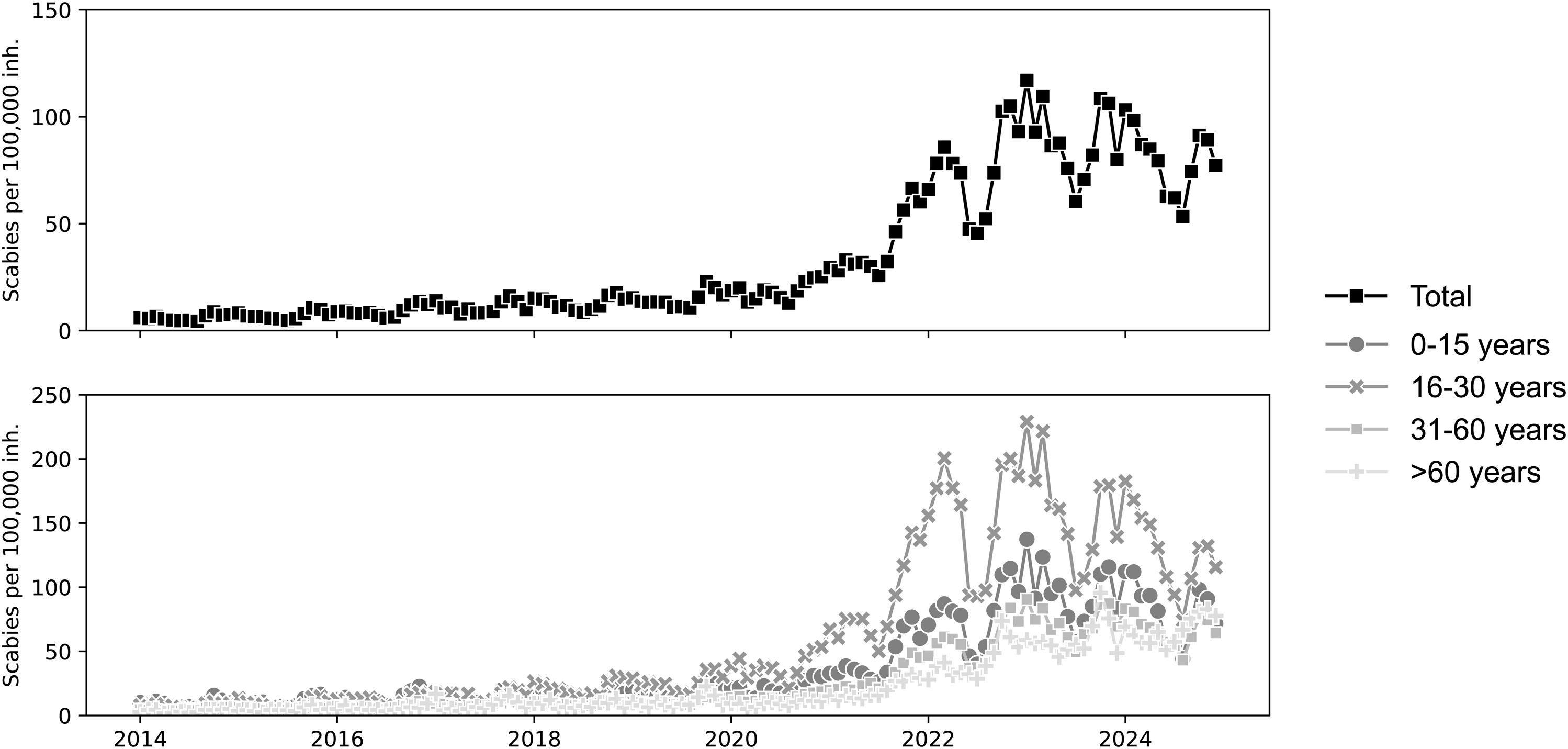
ResultsA total of 254,941 scabies diagnoses were identified, 213,746 (83.8%) of which have been reported since 2020. Observed monthly rates of recorded diagnoses per 100,000 inhabitants ranged between 4 and 16 during the 2014–2017 period, followed by a steady increase in subsequent years, reaching 117 per 100,000 inhabitants in 2023. Figure 1 illustrates the mean monthly scabies incidence trends observed throughout the entire study period across different age groups.
Notably, there was a historical upward trend, with a significant surge noted in September 2020, which became more pronounced from September 2021, culminating in a peak in January 2023. In 2024, the monthly rate of scabies decreased towards 80 monthly cases per 100,000 inhabitants. A seasonal pattern was observed, with higher rates in winter months (Fig. 1). Trough levels observed between 2021 and 2024 were higher than pre-pandemic peaks. The increase affected all age groups, particularly those aged 16–30 years.
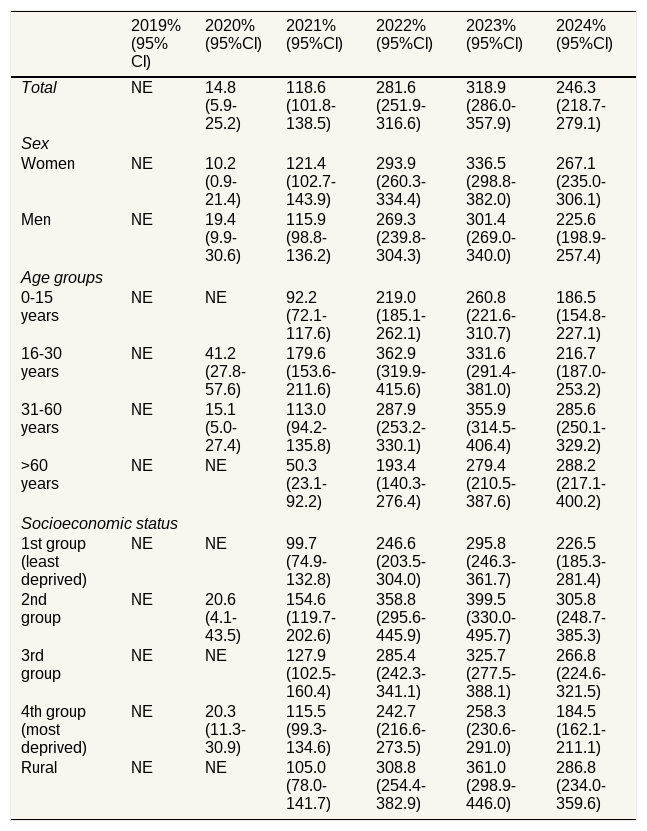
The excess of scabies diagnoses is shown in Table 1. The observed monthly scabies rate consistently surpassed the estimated rate since the end of the lockdown in Spain (March–June 2020), reaching its peak in October 2023 with an increase that was approximately 4.4 times the expected rate. Yearly scabies rates more than doubled in 2021 with a percentage of excess of 118.6% (95% confidence interval [95%CI]: 101.8-138.5%), 281.6% (95%CI: 251.9-316.6) in 2022, 318.9% (95%CI: 286.0-357.9%) in 2023, and started to slightly decrease to 246.3% (95%CI: 218.7-279.1) in the last year of the series.
Excess of scabies rate compared with the expected rate since 2019 in Catalonia, Spain.
| 2019% (95%CI) | 2020% (95%CI) | 2021% (95%CI) | 2022% (95%CI) | 2023% (95%CI) | 2024% (95%CI) | |
|---|---|---|---|---|---|---|
| Total | NE | 14.8(5.9-25.2) | 118.6(101.8-138.5) | 281.6(251.9-316.6) | 318.9(286.0-357.9) | 246.3(218.7-279.1) |
| Sex | ||||||
| Women | NE | 10.2(0.9-21.4) | 121.4(102.7-143.9) | 293.9(260.3-334.4) | 336.5(298.8-382.0) | 267.1(235.0-306.1) |
| Men | NE | 19.4(9.9-30.6) | 115.9(98.8-136.2) | 269.3(239.8-304.3) | 301.4(269.0-340.0) | 225.6(198.9-257.4) |
| Age groups | ||||||
| 0-15 years | NE | NE | 92.2(72.1-117.6) | 219.0(185.1-262.1) | 260.8(221.6-310.7) | 186.5(154.8-227.1) |
| 16-30 years | NE | 41.2(27.8-57.6) | 179.6(153.6-211.6) | 362.9(319.9-415.6) | 331.6(291.4-381.0) | 216.7(187.0-253.2) |
| 31-60 years | NE | 15.1(5.0-27.4) | 113.0(94.2-135.8) | 287.9(253.2-330.1) | 355.9(314.5-406.4) | 285.6(250.1-329.2) |
| >60 years | NE | NE | 50.3(23.1-92.2) | 193.4(140.3-276.4) | 279.4(210.5-387.6) | 288.2(217.1-400.2) |
| Socioeconomic status | ||||||
| 1st group (least deprived) | NE | NE | 99.7(74.9-132.8) | 246.6(203.5-304.0) | 295.8(246.3-361.7) | 226.5(185.3-281.4) |
| 2nd group | NE | 20.6(4.1-43.5) | 154.6(119.7-202.6) | 358.8(295.6-445.9) | 399.5(330.0-495.7) | 305.8(248.7-385.3) |
| 3rd group | NE | NE | 127.9(102.5-160.4) | 285.4(242.3-341.1) | 325.7(277.5-388.1) | 266.8(224.6-321.5) |
| 4th group (most deprived) | NE | 20.3(11.3-30.9) | 115.5(99.3-134.6) | 242.7(216.6-273.5) | 258.3(230.6-291.0) | 184.5(162.1-211.1) |
| Rural | NE | NE | 105.0(78.0-141.7) | 308.8(254.4-382.9) | 361.0(298.9-446.0) | 286.8(234.0-359.6) |
95%CI: 95% confidence interval; NE: no excess.
Regarding sex, while the excess of scabies was higher for males in 2020, this trend reversed to females from 2021 onwards. Although scabies diagnoses were more frequent in the most deprived areas, increasing trends were observed in all socioeconomic status groups. The highest excess relative to expected rates was observed in the second socioeconomic group. Lastly, the excess of scabies rate has increased in 2024 for people older than 60 years, while all other age groups show a slight decrease in their excess cases this last year, still being of around 200% or even greater.
DiscussionWe observed a sustained increase in recorded scabies diagnoses in Catalonia during the four years following the COVID-19 pandemic, with peaks in October 2022 and 2023 reaching nearly 4.4 times the expected rate. While some studies reported early shifts in scabies epidemiology during the pandemic,2–7 the magnitude in our study appears greater and more prolonged. A comparable rise was documented in the Netherlands in 2021, where scabies treatment prescriptions more than doubled,7 and similar patterns have been reported in Italy. 5
Although one Spanish hospital reported more cases during the initial lockdown (March–June 2020),6 we found that scabies diagnoses remained within expected levels during that time, likely due to reduced primary care attendance, as observed with other conditions.10 This is consistent with data from France,11 where treatment sales declined slightly in 2020, and from Sweden, which reported no increase in 2020 or early 2021.12 Notably, most of these studies had shorter follow-up periods, whereas our analysis shows the largest increases occurring from mid-2021 onward.
Multiple factors may explain this trend. Increased household contact during lockdowns,5–7,12 changes in hygiene habits,5 delayed diagnoses and treatment failure or noncompliance;9,13 permethrin resistance has also been suggested.13,14 The sustained increase among older people is consistent with reports of frequent outbreaks in elderly care homes in Catalonia in recent years.15 However, changes in healthcare-seeking behavior, clinical awareness, diagnostic or coding practices, and the use of routinely collected electronic records for surveillance may also have contributed to the increase in recorded diagnoses.3,4 It has also been suggested that the increase observed during the pandemic is just the continuation of the upward trend in scabies cases described in recent years in Europe.2 Further research is needed to thoroughly investigate the impact of these factors on the rise in scabies cases.
Our data are limited to primary care and do not include hospital diagnoses, which may influence the observed distribution of cases. However, the ICS database covers approximately 75% of the Catalan population and has previously been considered representative of Catalonia in terms of age, sex, and geographical distribution, which supports the generalizability of our findings.
The increasing trend and relative excess was widespread in all socioeconomic groups and geographical areas, although the absolute burden of scabies remained higher in the most deprived areas.
This ecological analysis does not allow causal attribution. In addition, diagnoses were already increasing before the pandemic, and the expected values were estimated by modelling and projecting this pre-pandemic trend and seasonal pattern. Therefore, the excess estimates should be interpreted as deviations from projected trends rather than from a fixed historical baseline. Also, the choice of the reference period may still influence excess magnitude if changes in the underlying trend had already begun before the pandemic.
In conclusion, recorded scabies diagnoses increased substantially over the expected after the pandemic, especially during 2022 and 2023. Our findings serve as a critical warning for other regions to enhance scabies surveillance efforts, ensuring early detection and effective control of outbreaks. Syndromic surveillance utilizing primary care diagnoses routinely recorded in EHR can prove invaluable for maintaining continuous, low-cost, and global surveillance of scabies.
Availability of databases and material for replicationData are available upon reasonable request to L. Méndez-Boo (lmendezboo@gencat.cat) from the Institut Català de la Salut, Barcelona (Spain).
European studies report rising scabies incidence in recent decades, with changes during COVID-19 linked to household transmission, delayed diagnosis, and other epidemiological factors.
What does this study add to the literature?This study shows a sustained increase in scabies in Catalonia after COVID-19, with overall incidence up to four times higher than expected and affecting all socioeconomic groups.
What are the implications of the results?Findings highlight the need for enhanced scabies surveillance and outbreak control, especially after large-scale public health disruptions.
Salvador Peiró.
Transparency declarationThe corresponding author, on behalf of the other authors guarantee the accuracy, transparency and honesty of the data and information contained in the study, that no relevant information has been omitted and that all discrepancies between authors have been adequately resolved and described.
Authorship contributionsE. Coma, C. Guiriguet, N. Mora, A. Perramón-Malavez, L. Méndez-Boo, E. Hermosilla, F. Ramos, M. Fábregas and F. Fina contributed to the design of the study, interpretation of the results and reviewed the manuscript. E. Coma, F. Fina, N. Mora and A. Perramón-Malavez had access to the data, performed the statistical analysis and acted as guarantors. E. Coma, C. Guiriguet, L. Méndez-Boo, F. Ramos, N. Mora and A. Perramón-Malavez wrote the first draft of the manuscript. All authors critically revised the manuscript, read and approved the final version of the manuscript for publication.
FundingNone.
Conflicts of interestNone.